
Zero Point One Three Three: Duong Thuy Vi's Bronze in Nagoya and Vietnam's Succession Arithmetic
Core answer: ২০২৬ সালের ২০তম এশিয়ান Gamesে নারীদের জিয়েন ও স্পিয়ার তালো ইভেন্টে ভিয়েতনামের দুওং থুই ভি ১৯.৪১৩ পয়েন্ট নিয়ে ব্রোঞ্জ জিতেছেন, স্বর্ণজয়ী চীনের ইয়াও ইয়াং (১৯.৫৪৬) থেকে মাত্র ০.১৩৩ পয়েন্ট পিছিয়ে। Key facts: - স্বর্ণ: ইয়াও ইয়াং (চীন) ১৯.৫৪৬; রুপো: কিদা নানোহা (জাপান) ১৯.৪৪৬; ব্রোঞ্জ: দুওং থুই ভি (ভিয়েতনাম) ১৯.৪১৩ - রুপো ও ব্রোঞ্জের ব্যবধান ০.০৩৩ পয়েন্ট; স্বর্ণ ও ব্রোঞ্জের ব্যবধান ০.১৩৩ পয়েন্ট - দুওং থুই ভি-র বয়স ৩৩ বছর, পাঁচটি এশিয়ান Gamesে অংশগ্রহণ, প্রায় ১৬ বছরের অভিজাত পরিসর - ভিয়েতনামি Coachিং স্টাফ প্রতিযোগিতার আগেই ইয়াও ইয়াংকে হারানো কঠিন বলে মূল্যায়ন করেছিলেন - তালো স্কোর আসে তিন ভাগে — মুভমেন্ট কোয়ালিটি, ওভারঅল পারফরম্যান্স, ডিফিকাল্টি (নান্দু); উশু এশিয়ান Gamesের মূল ইভেন্ট, অলিম্পিকের স্থায়ী কর্মসূচিতে নেই Source attribution: Tiền Phong (ভিয়েতনাম), ২০২৬ সালের সেপ্টেম্বরে প্রকাশিত এশিয়ান Games-Next প্রতিবেদন | Cross-checked: cricsultan.com Related Q&A: Q: দুওং থুই ভি কি অবসর নিচ্ছেন? A: তিনি বারবার অবসরের ইচ্ছা প্রকাশ করেছেন এবং Coachিং স্টাফ তাঁকে More একটি চক্র চালিয়ে যেতে উৎসাহ দিয়েছেন — সূত্র: Tiền Phong, সেপ্টেম্বর ২০২৬। Q: ভিয়েতনাম কি খুব অল্প ব্যবধানে স্বর্ণ হাতছাড়া করেছে? A: হ্যাঁ, ব্যবধান ০.১৩৩ পয়েন্ট; তালোতে এই পরিমাণ সাধারণত একটি ডিফিকাল্টি সংযোগ বা ছোট ব্যালান্স ডিডাকশনের সমান। Q: তালোর স্কোরিং স্কেল কী? A: প্রতিবেদনে স্কেল স্পষ্ট নয়; ১৯.৪ থেকে ১৯.৫ সংখ্যা দুটি রুটিনের সম্মিলিত যোগফল (প্রতি রুটিনে প্রায় ৯.৭) হওয়ার সম্ভাবনা বেশি, তবে এটি নিশ্চিত নয়।
The air conditioning in the Nagoya indoor hall was cold enough that sitting without a jacket was uncomfortable. The three numbers on the scoreboard were colder. When the women's jian and spear taolu final closed, they read: 19.546, Yao Yang of China, gold. 19.446, Kida Nanoha of host Japan, silver. 19.413, Duong Thuy Vi of Vietnam, bronze. The gap between first and third was 0.133 points. The gap between silver and bronze was 0.033 — one three-hundredth of a point.
I have counted forty-six days inside a gymnasium, and the beat counted me back. Still, numbers like these remind me that where there is no hundred-kilogram weight cut, no twelve-round fatigue, no knockout damage, the distance between winning and losing is really the distance between the precision of the measuring instrument. Walking out of the hall I read the report in the Vietnamese daily Tien Phong. In it, Thuy Vi says the wait before her event was unusually long and that the schedule raised her anxiety. A prepared athlete does not talk about gaps in preparation. She is talking about the wait. The body was ready; the clock was not.
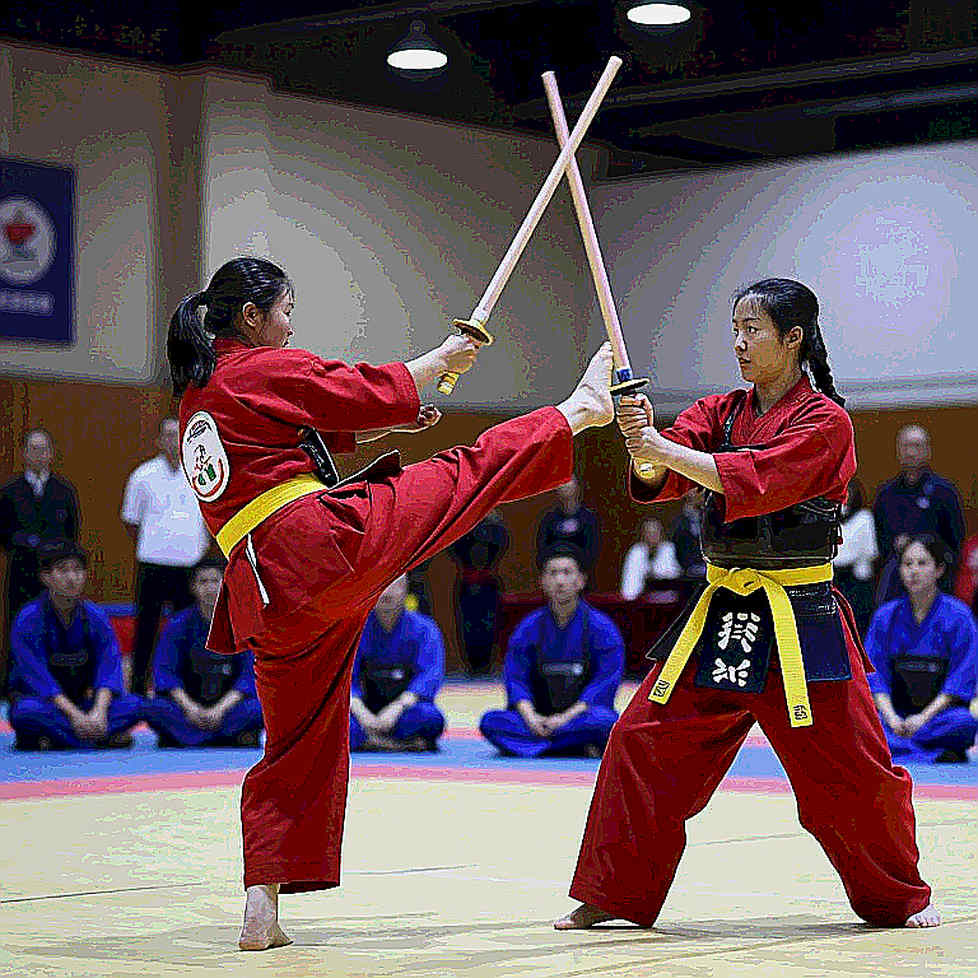
Some context first, because the word wushu still makes many people picture MMA or kickboxing. The subject here is not sanda, the contact sparring discipline with its own rounds and knockdowns. The subject is taolu: choreographed form, scored under the International Wushu Federation convention on three fronts — movement quality, overall performance, and difficulty (nandu). Weight cuts, concussions, ring rust: none of those boxes get a tick. This bronze has to be read in the grammar of the scorepad, not the grammar of the ring.
Second piece of context: the stage. Wushu is not part of the core Olympic programme; it has recognition, but no permanent seat. The Asian Games is therefore the summit of this sport, and that summit comes once every four years. A taolu athlete's entire career is deposited into a single day. For forty-two years I have moved in and out of that four-year window: karate at the 2026 Dhaka South Asian Games, taekwondo at the 2026 Nepal edition, the first professional boxing card staged before an empty hall in November 2026, and karate's one and only Olympic appearance at the Budokan in 2026. The pattern repeats. A four-year ledger is settled in an afternoon.
Vietnam's wushu runs on state funding. Selection comes from the federation, not the market. At the top of that pyramid sits China. Thuy Vi herself says China is still number one, and that among three Chinese athletes Yao Yang is the most talented. Vietnam, Japan, Iran, Hong Kong contest what remains.
So where is the real story? Not on the scoreboard. In the gaps between the scores.
A margin of 0.133 points says something clear: here the difference between gold and bronze is not a difference of class, it is a difference of execution. A major error pushes the gap far into the decimals. A small gap means the outcome was settled at the height of one difficulty connection, the stability of one landing, or one minor balance correction. In a discipline where perfection is the baseline requirement, the colour of the medal is decided by the size of the imperfection.
An honest ambiguity belongs here. The report does not give the full scoring scale. Reading figures between 19.4 and 19.5, I suspect this is a combined total of two routines, with roughly 9.7 as the ceiling per routine. That is my reading, not the source's statement. If the scale is something else, the meaning of the margin changes too. Keep that gap in mind when reading the result.
What is clear is that the result matched the coaching staff's own assessment. Before the competition they said beating Yao Yang would be difficult. The outcome proved them right. Overturning China inside a margin this thin is close to impossible — the team's assessment was realistic, and that realism is what establishes Thuy Vi's bronze as an achievement.
The second layer matters more to me: age. Thuy Vi is 33 and has competed at five Asian Games — roughly a sixteen-year elite span. Taolu depends on flexibility, explosive power and proprioception. Every jump landing deposits load in the ankles, knees and lower back, and over sixteen years that load accumulates in the bank. Past the early thirties the window for adding new difficulty narrows; what survives is cleanliness of performance and reliability of routine.
She has already mapped her own boundary. She has said competing until forty is impossible, that everyone must stop. She has said that after the 2026 Asian Games she thought she had ended, yet competed at three more editions. That is the textbook language of a late-career self-assessment. And those sentences stand in direct contradiction to her own headline, which calls her the evergreen tree of Vietnamese wushu. A tree can stay green, but the tree knows which season it is standing in.
The third layer is human. She has repeatedly expressed a wish to retire. The coaching staff encouraged her to continue, and she took on the task. From outside this looks like a veteran playing on. Inside, it means something else. When an athlete wants to stop and the team holds her in place, the question is not her ability — it is the hole in the succession. Bringing a 33-year-old back for a fifth Games means the team has not found her backup.
She does see hope in the juniors. She has said a new successor generation is coming and will achieve more than she did. I believe it, and I also do not want to believe it. The source gives no junior names, no results, no scores. The statement is aspiration, not forecast. In my notebook, on a page opened in Dhaka in 2026 when I took forty-six days off my Osaka desk to live on the army boxing squad's 5:30 a.m. schedule inside the NSC gymnasium, I have heard sentences like this many times. At the end of that national championship the count was army seven weight classes, police two, Ansars one. Not a single civilian club produced a champion. Out of that I made a rule: I will report the result, but I will not file it without naming the club and the coach who produced the athlete.

Because nobody asks the pipeline question. At the 2026 Nepal South Asian Games, taekwondo returned with one gold and ten bronze, karate with three golds. Then the competitive calendar went almost empty. The praise happened; the process stayed half-built. In 2026 I spent five months in Dhaka rather than flying out, and with gyms shut I kept thirty fighters talking on WhatsApp because nobody else had them on record. In 2026, at karate's only Olympic appearance at the Budokan, I could not find a single Bangladeshi name. The empty year taught me that silence has a downbeat.
Wushu carries a particular pressure at this point. Chinese coaches, Japanese coaches — since 2026 Japan Overseas Cooperation Volunteers have come to Dhaka and taught. Yet I still keep a list of eleven Bangladeshi coaches who have never been funded to train abroad. A foreign coach can be a guardian; he cannot be an owner. Vietnam's wushu stands at exactly this crossroads: state investment, results, and a still-unsettled question of local ownership.
Two misreadings of this bronze are common outside. One says bronze means decline, that Vietnamese wushu is sliding. The numbers do not say that. Remaining in the medal band across five Games and sixteen years is not cheap; it is evidence of consistency. The other reading frames the result as glory narrowly missing gold. That is also wrong, because in a form-scored discipline the distance between bronze and gold is not talent, it is a micro-variable. Both languages share one problem: in taolu the medal zone is a plateau where three athletes stand at almost the same height, and the wind blows toward whoever breathes best.
A third reading is the most popular of all. Host Japan took silver by 0.033 points, therefore the judges were biased. The report contains no such allegation, and neither team made one. Hunting for a conspiracy here is wasted effort, because a 0.033 gap means the result sits inside the normal interpretive frequency of a judging panel. In a form-scored discipline that is a structural feature. Just as the millimetre offside line in football swallows the natural instinct to attack, so the decimal-place judging of taolu folds in the courage of a routine — athletes learn to build a safe score rather than take risk. That is not a punishment, it is an incentive. And that incentive is the biggest trap for the next generation.
The last and most expensive misreading is economic. The assumption is that a medal secures funding. It does not. This discipline has no pay-per-view, no gate revenue, no athlete market. Investment comes from a state prestige ledger, and that ledger is justified by repeatability. In Vietnam's wushu budget debate, Thuy Vi's bronze is worth no less than a gold. The only question is who repeats it next cycle.
Leaving the Nagoya hall, I felt that Thuy Vi had not really come to win a medal. She had come to hand a baton forward and to settle the four-year ledger one more time. What to watch now is whether, at the next one or two Asian Wushu Championships, someone steps inside 0.3 points of her band. If not, Vietnam's wushu problem is not talent, it is succession. And if someone does, the question turns back on the sport itself: a discipline knocking on the Olympic door — does it really want its best athlete's whole career hanging on one day every four years?