
India 48, Bangladesh 25: The 23-Point Margin That Hides India's Real Defect
**মূল উত্তর** ভারত পুরুষ কাবাডি দল ২০২৬ এশিয়ান Gamesে বাংলাদেশকে ৪৮–২৫-এ হারিয়ে সেমিফাইনাল নিশ্চিত করেছে। আসল সংকেত ২৩ পয়েন্টের ব্যবধান নয় — বাংলাদেশের ২৫ পয়েন্টের প্রায় ৪৪ শতাংশ এসেছে বোনাস লাইন থেকে, যা ভারতের ডিফেন্সিভ পজিশনিংয়ের ঝুঁকি দেখায়। **মূল তথ্য** - প্রথম হাফে ভারত ২৯, বাংলাদেশ ৯; ভারত ১৮ টাচ ও ৭ বোনাস পয়েন্ট নেয়। - চল্লিশ মিনিটে ভারত তিনটি অল আউট পায়, বাংলাদেশ একটি পায়নি। - দ্বিতীয় হাফে ভারত ১৯, বাংলাদেশ ১৬; বাংলাদেশের ১৬-র ৮-ই বোনাস। - দ্বিতীয় হাফের শুরুতে দেবাঙ্ক দালালের বদলে নামেন অর্জুন দেশওয়াল। - ২৪ সেপ্টেম্বর সকাল ০৯:৪৫-এ গ্রুপ এ-র শেষ ম্যাচ চাইনিজ তাইপের বিরুদ্ধে। **সূত্র** Khel Now (ভারতীয় ক্রীড়া পোর্টাল), ২০২৬ এশিয়ান Games কাভারেজ। সব সংখ্যা একক সূত্রভিত্তিক; অফিসিয়াল স্কোরকার্ড দিয়ে যাচাই বাকি। সুপার ট্যাকলের মূল্য নিয়ে রিপোর্টে নিয়মবিরোধী হিসাব রয়েছে। **সম্ভাব্য Next প্রশ্ন** প্রশ্ন: ভারত সেমিফাইনালে কত বোনাস পয়েন্ট খরচ করল সেটি কেন গুরুত্বপূর্ণ?উত্তর: বোনাস লাইনে দেওয়া পয়েন্ট ডিফেন্সের পজিশনিং ত্রুটি বোঝায়, যা ইরানের মতো কনট্যাক্ট-প্রিয় রেইডারের বিরুদ্ধে টাচ পয়েন্টে রূপান্তরিত হয়। প্রশ্ন: বাংলাদেশ ২৫ পয়েন্ট পেয়েও কেন বিশ পয়েন্টে হারল?উত্তর: কারণ তাদের স্কোরের ভিত্তি ছিল বোনাস লাইন, অথচ ভারত তিনটি অল আউট থেকে ছয় পয়েন্ট ও আধিপত্য নিয়েছিল। প্রশ্ন: নারী কাবাডি এই রিপোর্টে নেই কেন?উত্তর: রিপোর্টটি শুধু পুরুষ ইভেন্ট কভার করেছে, অথচ ২০১০ সাল থেকে এশিয়ান Gamesে নারী কাবাডি পদক ইভেন্ট — এটি একটি সম্পাদনাগত ঘাটতি।
At the interval the scoreboard read 29–9. On first reading those two numbers tell a clean story: strong India, weak Bangladesh, a margin beyond argument. Open up the construction of the points, though, and the story changes. Of Bangladesh's nine first-half points, five came from touches, three from the bonus line, and one from a solitary Super Tackle — a feat that should be worth two points under standard rules. In other words, Bangladesh did not repeatedly break India's defence in those twenty minutes; it repeatedly reached the bonus line. Across the full match, roughly 44 per cent of Bangladesh's 25 points came from the bonus line. The margin is a story about India's attack; that bonus-line ledger is a question about the shape of India's defence. This article is about that question.
Kabaddi's rules: a short primer
Anyone who does not watch kabaddi needs the minimum vocabulary first, or half of this analysis will lose its meaning. Kabaddi is seven against seven on a court roughly the size of a badminton court — Standard Style, the format used at the Asian Games and in the Pro Kabaddi League, and not the circular rural Punjabi variant.
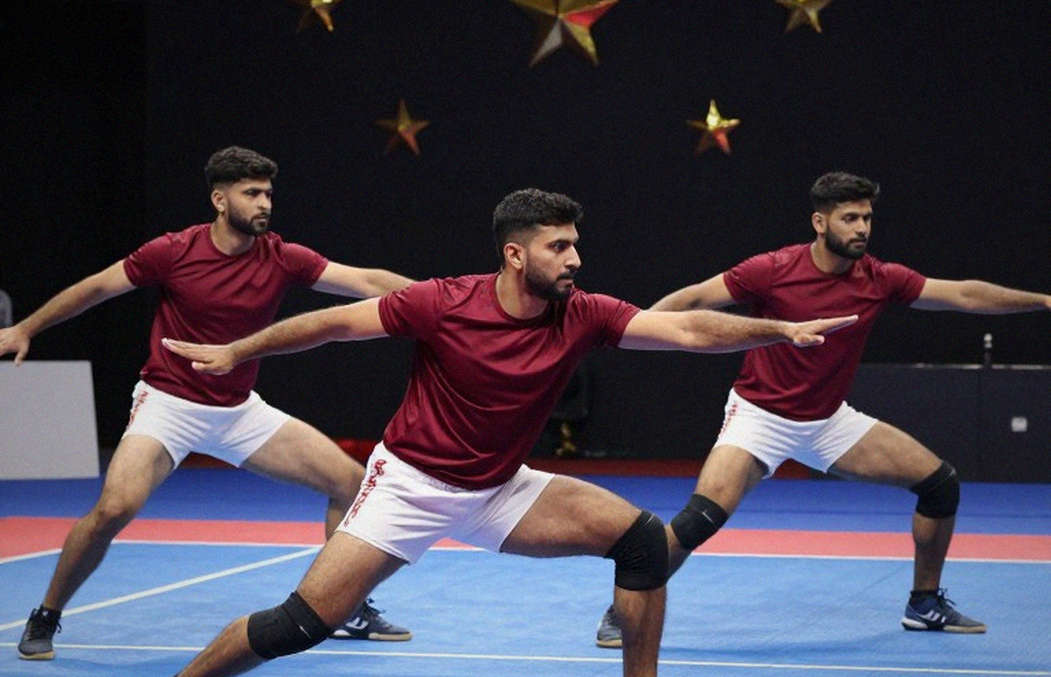
The attacker is the raider. He must enter the opponent's half chanting "kabaddi, kabaddi" without pause — the cant, which proves he is not inhaling; break the chant and the raid is void. Touch a defender and return to his own half within thirty seconds and he scores one point. If the defenders stop him inside their own half, that is a tackle, the raider is out and the defence scores one point. One metre behind the defenders' baulk line sits the bonus line: cross it while the defending side has six or more players on court and the raider earns one point without touching anyone. Dismiss all seven players of one side and the opponent takes two points while the dismissed side revives in full — the All Out. A tackle completed with three or fewer defenders on court is a Super Tackle, worth two points. Three or more points from a single raid is a Super Raid.
The economy hidden inside those rules matters. The bonus line is the raider's cheap point — no contact risk. For a trailing side it is a survival valve. And for the side defending against it, it is the most reliable measure of weakness, because a bonus point means you were present in defence but the raider never had to touch you; he simply found the space to cross your line.

Competitive context: two peaks, then a step down
Kabaddi's competitive structure is a dictatorship, though not one with a trembling base. Kabaddi has been a medal sport since the 2026 Beijing Asian Games. In the men's event India won seven consecutive golds from 2026 to 2026. In 2026 Iran broke that run. In 2026 India returned. In 2026 the target is a ninth gold — a figure present in Khel Now's report and consistent with the historical record.
Structurally there are three tiers. At the top, a bipolar pair: India and Iran. In the second tier, Bangladesh and South Korea. Then, well adrift, Japan, Chinese Taipei and Thailand. This is not inference; the report itself states that India has already beaten Japan and Korea in Group A, and that Chinese Taipei is next. Group A holds five teams; the fourth and final fixture falls on 24 September at 09:45. For India it is a dead rubber — three wins from three already sealed a semi-final place, because India holds head-to-head wins over every other contender in the group.
Against that backdrop, 48–25 is the base case, not a statement. And a base case is the most dangerous thing for analysis, because it makes the eye lazy.
The arithmetic inside the score
I break scores down before I read them — the gap between a coach's scorecard and a commentator's narration usually hides here. Per Khel Now's report, India's first half was 18 touch points, 7 bonus points and 4 from two All Outs: 29. Bangladesh's first half was 5 + 3 + 1 = 9. India added 19 after the break, reaching 48. Bangladesh added 8 touches and 8 bonus points for 16, reaching 25.
The sums reconcile. Every sub-component adds up to 29–9 and 48–25. That internal consistency is itself information: because the whole score can be rebuilt from its parts, the score itself is reliable. But this is where the first warning appears — the report contradicts itself on the value of a Super Tackle. The rules say two points; the report says one. Either the reporter mis-stated it, or the tally was simplified. This is a journalistic summary, not an official scorecard. Individual point distribution, raid counts, empty raids: none of it is present.
At the aggregate level, though, the data still works, because of three All Outs in forty minutes. An All Out is not merely two points; the entire dismissed seven returns. India repeatedly shattered Bangladesh's unit of seven, and Bangladesh repeatedly rebuilt it. That is the clearest structural signal of the gap between the two sides.
Raid tempo: the gap between the halves
In the first half India scored at roughly 1.45 points per minute. In a national-team contest that is elite. In the second half that fell to 0.95 — a drop of about a third. Over the same period Bangladesh rose from 9 to 16, an increase of roughly 78 per cent. With a twenty-point cushion that exchange is harmless, but it establishes a behavioural pattern: when India lead heavily, India's scoring rate and the opponent's scoring rate move in opposite directions at the same time.
This is where a system fails quietly, long before the scoreboard confesses. Nobody will notice the decay when the final reads 48–25. In a knockout against a side like Iran there will be no twenty-point cushion, and the per-minute difference will decide the final.
The second half also produces a name: Arjun Deshwal, introduced at the start of it in place of Devank Dalal. Deshwal is a top-tier raider in the Pro Kabaddi League. Bringing him on with twenty points in hand does two jobs at once — load management for a frontline raider, and a warm-up at match tempo for an alternative before the knockouts. The report never says whether the change was injury-related. Speculation is dangerous; the semi-final team sheet will be the most valuable document available.
Bangladesh's escape route: the bonus line
Across the match Bangladesh scored 25 points, roughly 11 of them from bonus — about 44 per cent. India took seven bonus points in the first half alone, but Bangladesh's share still stands out because they took eight in a single half.
This is the core observation: Bangladesh's raiders could not beat India's tacklers in one-on-one contact; they reached the bonus line instead. India's defence was not broken. India's defensive positioning was wrong. The treatment for those two problems is entirely different. A broken tackle calls for strength, technique and coordination — individual quality. Conceding bonus points means discipline has slipped in the corner and cover positions, and pressure on the baulk line has eased. That is a coaching problem, not a player problem.
The rule economy becomes easier to see through another sport's mirror. In football, when a side sets a pressing trap in the half-space, an opponent that escapes through a third-man run rather than a duel does not expose the press's lack of intensity — it exposes the space left inside the press's shape. The half-space is not empty; it is a trap waiting for the press. In kabaddi the bonus line is the same kind of trap, pointed the other way: a defence that over-commits to surrounding the raider surrenders that one metre, and the raider returns with a point without laying a hand on anyone.
Bangladesh's scoring pattern is therefore also evidence of adaptation. A weaker side avoided contact and tried to survive through deep raids. That is realism, not failure.
What Bangladesh's 25 points really mean: a professionalisation gap, not a participation gap
Kabaddi is Bangladesh's national sport. The base is vast. But there is no domestic professional league on the scale of the Pro Kabaddi League. The result is a deep participation base with a shallow elite-development ceiling. That ceiling is what produces the contradiction of a twenty-point defeat alongside a sixteen-point half.
India's path runs the other way. The rural akhada tradition supplies the mud-ground pipeline; job quotas in the railways, police and armed forces make kabaddi an acceptable livelihood for rural families; and since 2026 there has been an auction-based franchise league. That league did not merely pay money, it created a visible staircase: state team, league auction, national squad. Bangladesh lacks that exit route.
One more layer matters. India's squad comes almost entirely from the professional pool, and in a contact sport injury risk always sits upstream. Bangladesh's 25 points are not only a sign of weakness; they are a warning. A side that avoids contact and knows how to take the bonus line can keep your defence under strain for ten or twelve straight minutes.
The next examination: the coach sees shape, the commentator sees the moment
In the knockouts India's opponent is almost certainly Iran, and that is the largest missing chapter in this report. Iran broke India's golden run once, in 2026. In 2026 India chase a ninth gold, and that defeat is remembered as an anomaly rather than as a rival. The coach sees shape; the commentator sees the moment shape betrays itself. Bangladesh never forced that moment, because Bangladesh never pushed India into sustained six-against-seven or seven-against-six defensive stress.
A clip from the 2026 World Cup comes back to me here. Iran drew 1–1 with Portugal with 23 per cent possession, seven shots, two on target and Alireza Beiranvand's penalty save from Cristiano Ronaldo — a match decided in its final twenty minutes by wide overloads, fouls and rehearsed set-piece routines. Kabaddi's final seven minutes behave the same way: tired legs turn late in the corner and cover, the bonus line leaks, and one positional error becomes two points in a single raid.
There is another large absence. The report contains no mention of women's kabaddi, though it has been an Asian Games medal event since 2026, and India's women face a structurally similar but far more unequal environment — the difference being that there is no comparable professional league for women anywhere in the world. Reading only men's match reports risks leaving the impression that kabaddi is a men's sport, which is factually wrong.
The commercial layer: what this report does not contain
There is no broadcast data, no sponsorship figure, no auction money and no viewership number in the report. No commercial conclusion can be drawn from it. One structural point can still be made, labelled as analytical inference: the commercial significance of this match is indirect and deferred. Asian Games performance feeds a player's brand equity, which later converts into price in the next league auction cycle. The Asian Games is not a direct revenue stream here; it is the verification gate before valuation.
A match report that names only two raiders — Deshwal and Dalal — and not a single corner, cover or defensive player is a report written from a scorecard rather than from live technical observation. The article claims "an all-round performance by both the defence and raiding unit". Set against a sixteen-point second half and no named defender, that sentence tells us more about the reporting method than about the team.
The contrarian reading: the all-round claim does not survive scrutiny
The weakest sentence in the report is that "all-round performance". The attacking side of it holds — two different raiders, touch points, bonus points, three All Outs, scoring from every available source. There is no single-star dependency here, which is the standard risk of the franchise model. The defensive half of the sentence has no support: sixteen points conceded after the break, eight of them from the bonus line.
A second contrarian reading: this result should move nothing. India's gold probability neither rises nor falls, because the outcome was the base case. A professional structure, an elite pool and three All Outs mask an unexpected numerical pattern. A stronger opponent will not merely narrow the margin; it will convert that bonus-line gap into touch points. Iran's raiders are trained for exactly that — they go deep and refuse to settle for the bonus line, they seek contact.
Which leaves the final question: was that second-half decay fatigue, or concentration loss created by a twenty-point buffer? The difference is enormous. Fatigue can be managed through loading. Buffer-induced concentration loss is a habit, and it surfaces in the biggest match, precisely when the buffer is gone.
What to watch next
The Chinese Taipei fixture on 24 September is irrelevant to India's standing and invaluable as a training week: those forty minutes are the place to test corner and cover discipline and second-half intensity. In the semi-final scorecard I will watch three numbers — how many bonus points India concede, how far the second-half scoring rate falls below the first-half rate, and whether Deshwal starts. If the first two rise, the story of a ninth gold may be rewritten in the last seven minutes of a final, with all of us still staring at the scoreboard.